An Introduction to «Storylines»
December 12th 2025
«Storylines» is the title of a group of works that emerged from my intensive, years-long search for a personal art practice. The framework of «Storylines» allows me to reflect on topics such as signs, code, and language — how they interact, how they are (mis)interpreted, and how they can be manipulated. It is also a quest into their relationship with both the visible and the invisible. The visible in the sense that they are expressed visually and eventually escape the screen to emerge on a physical medium, such as paper; the invisible in the sense that they continue to govern what remains unseen — as underlying patterns, as code speaking only to machines such as laser cutters, and as ideas and visions that exist solely in our minds. In a broader perspective, «Storylines» seeks to reconcile the digital and the analog, computation and intuition, science and art.
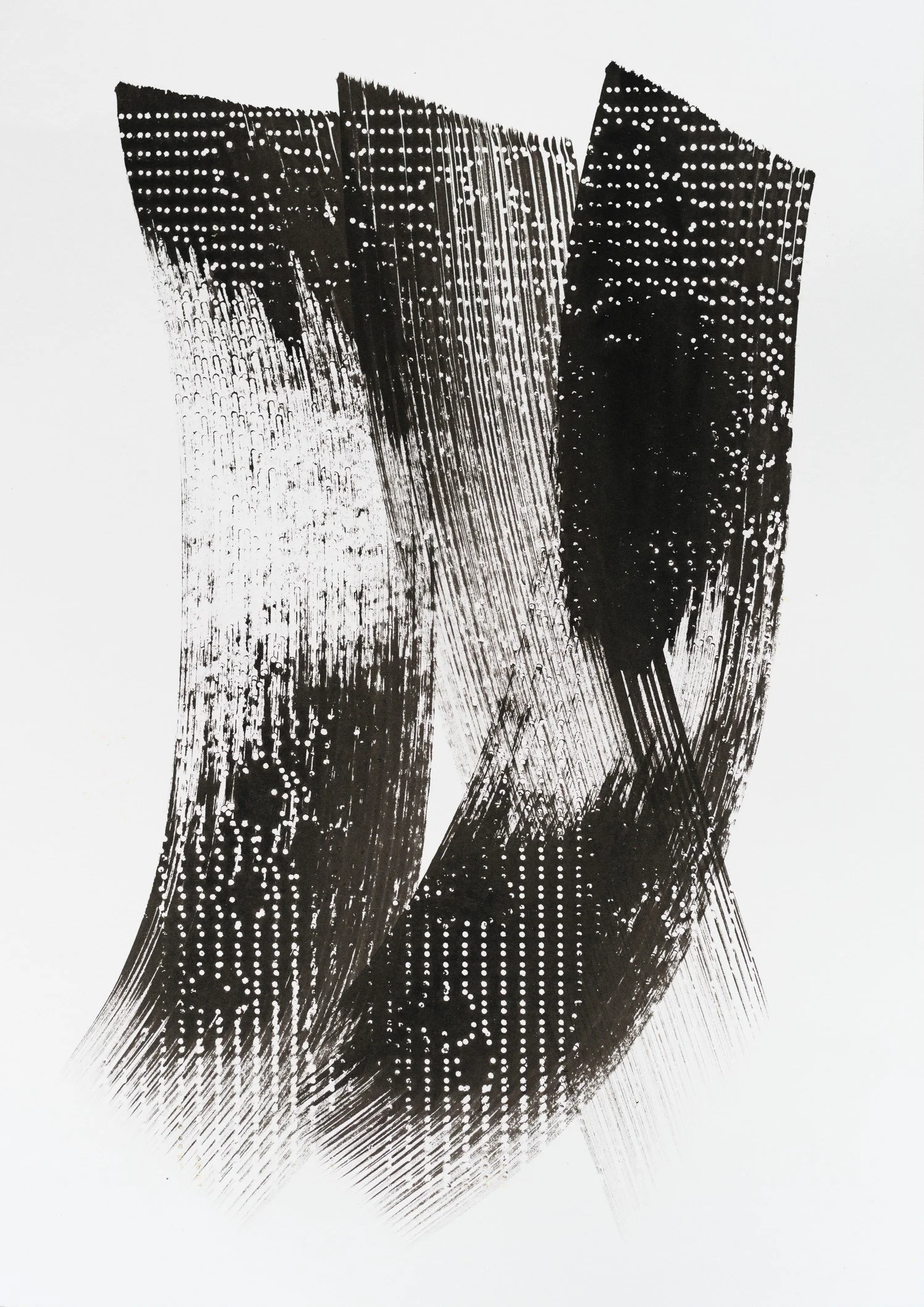
The picture you see is one of the first sketches I made this year (Sketch for Storylines, 2025, Ink on paper, 42 x 29.7 cm). It is based on an algorithm that converts text into Braille, the tactile script used by visually impaired people. In this case, the input is simply the letter “c,” which spans a grid and gives rise to almost 5,000 dots on a DIN A3 sheet. But it does not stop there; two layers of manipulation then shift the dots, adding further layers of interpretation and fundamentally changing the story. The dots become visible only through ink applied intuitively with bold brushstrokes — gestures that reference calligraphic practices which for centuries have shaped a discourse on signs, their visualization, and their transformation into meaning beyond single letters and words.
By representing “c” in dots, the character is also digitalized within a 2×3 matrix. Interestingly, there is a Braille system based on a 2×4 matrix, extending the possible representations from 64 to 256, or 8 bits. While reading the dots visually may seem overwhelming, touch appears much more suitable for reading digitally (this is just my own notion — I would love to hear your thoughts). Even though my current artworks are not tactile yet, they retain an element of “haptic visuality,” a term coined by art theorist Laura U. Marks. The sensation of touch is still evoked simply by looking — for instance, an image of broken glass can alarm you and recall memories of cutting yourself. Similarly, the small dots draw you in, inviting you to come close enough to touch them, while the bold brushstrokes push you back and appeal primarily to the eye, since they want to be perceived from a distance. In this sense, the artworks of «Storylines» begin to glimmer, as they can never be fully grasped: you are always either too close to see the whole picture or too far away to perceive the details. This effect becomes even more pronounced in my larger works.